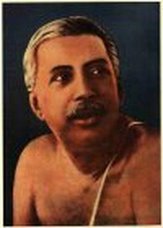
DISCOURSES(Some of the notes of conversations with Sri Sri Thakur Anukulchandra picked up & collected by Shri Prafulla Kumar Das. Published in book form “Discourses” by © Satsang, Deogher).
October 5, 1939
The darkness of the night set in. Sri Sri thakur was seated on a chowki in the Ashram courtyard by the river bank, and some people of the ashram were with Him. Gopalda came. Thakur said to him, "The Manu-Samhita starts with a description of the beginning of the cosmic cycle, and there is some real sense in that. By understanding things in the order in which they appear one can get a proper understanding of them. Chalar Sathi (Life's Companion) starts with the creation of the universe. I did not make any great plans for it that way; it turned out that way of itself. Unless we are acquainted with the elementals, our knowledge is only of bits and pieces, and we don't come to a full understanding. What big scientists our ancient seers were none today understands. A great ascetic like Mahadev, for example, was responsible for a great many medical formulas. People today generally have a distorted picture of saints. But the real saints were very active and practical. In how many ways they served the society!"
In the course of His talking, Thakur said, "I do not see another normal man around like Ramakrishna." Later in the night prayer and meditation were discussed. Thakur said, "These things don't fit in well unless one has a normal life. A posed or `got-up' life will never do, I have never obtained anything by going through gymnastics for it. I would do things when I felt like it. I never saw Sarkar Saheb. That is why my mother was everything to me. Whatever I would do would be to gain credit with her. If fancy so pleased me I would begin repeating Name in the dead of night. I always had a strong urge to do things swiftly Once I walked three miles from Khoksa in 22 minutes. My activity became intense, and I enjoyed my work all the more. I would do Kirtan. I n the period of trance consciousness would be lost. But I do not attach any importance to that. At other times I was always conscious. When I grasped a thermometer one day, the temperature went up to 110 degrees. Water sprinkled on my body would evaporate. Such things happened. Visions like those I discussed with you before would come.
"People do not understand the meaning of God. They go on with queer ideas in their heads and do all sorts of peculiar things. That's why they don't get anywhere. Those who get the association of the great really get fulfillment. What cannot be understood by ascetic practices can be understood by them, seen by them, normally. And this again cannot happen unless one leads a normal life.
October 9, 1939
In the evening a gentleman from Calcutta came and desired to know how to make progress in business. Sri Sri Thakur said, "Yajan (self-exaltation), Yaajan (the exaltation of others), and Ishtabhriti (the maintenance of one's Ideal) are the foremost duties of man. One must exert oneself for one's becoming, and at the same time convince the environment to do the same. Man cannot get by, ignoring his environment. That is why it is to a man's interest to serve his environment. At every turn Yaajan and service are required. Say, for example, you have a cycle shop. You start thinking how to supply everyone with a cycle. Perhaps you think to supply even a poor man by letting him pay in installments. You do Yaajan with him about how convenient it would be for him to have a cycle. When he goes in for a cycle and enjoys its advantages, he will express a heartfelt gratitude for what you have done, saying, "Such and such a man has considered my financial position and has made it possible for me to have this cycle. Had he not given me special consideration, I would never have had it. He made it very easy for me." Hearing his words, many pour into your shop, and thus your business begins to thrive. If instead of this you had looked for greater profits by cheating him, he would probably have detected it and said to others, "Look out, don't go ever to that man's shop. He is a cheat." If you have a thousand customers and you get a very small profit from each of them which they know about, is that not better than taking a greater profit from a hundred? The Sanskrit word for business comes from a root meaning, "That which truly saves from death." "But whatever you do, have love for your Ideal at the root of it. Passions then remain in your control. Serviceable attitude arises. Work becomes flawless. Whoever comes in contact with you sticks to you like glue, enchanted with your Ideal-fulfilling service and attitude. Human wealth increases. And progress becomes inevitable. Man becomes eligible for good out of this attachment for Ideal. That is why Guru is called man's Supreme Good. Only by following him can man have good."
October 11, 1939
It was about ten o'clock in the morning. Sri Sri Thakur was seated on snow-white bedding, his feet bare, a thick sacred thread hanging from his shoulder. He was talking about this and that with Gopal da, smiling. Haripada da, Kalidasima and others now and again gave him tobacco, water and betel nut. Thakur caught sigh of dentist examining Bhushnima's teeth by the side of the temple stairs. The dentist was dressed in European fashion. Thakur commented, "When the boys of our country finish their studies and become professionals like doctors, pleaders, or barristers, they put on sahib clothing. This seems to me very insulting. Our Bharadwaj may be a big physician but principally he is a Ritwik (a guardian in the society). All of his activities come out with that as their ground. Whatever he becomes, he cannot give up his characteristic headgear and sash." Thakur turned to Gopalda. "If you turn out to be a big shot and still wear your Ritwik's dress though surrounded by bodyguards and attendants got up in tight fitting suits, how grand you will look! When a man stands clad in snow-white vest shirt and wrapper, he looks like an angel."
October 12, 1939
Sushilda was back in ashram today after collecting information on memories of previous births. He described his findings in detail to Sri Sri Thakur's great enjoyment. At one time he said, "I examined the horoscope of two such persons (those who could remember their previous births), and I found that both had been born in the same astral combinations as they had previously died in!" Sri Sri Thakur and Gopalda jumped up simultaneously. They shouted joyously, "Is it so, really ! The very thing we guessed !" Sri Sri Thakur said, "Gopal, now you must look into this thing thoroughly, I said so a long time ago. After all is said and done, we have not been able to discover the key to memory-continuity. The question remains, how is it possible to remember incidents of previous births ? This is the only problem in the world. And it doesn't seem to be something unsurmountable. If one can find the trick, the thing is done. If man achieves this, what he does not know. As long as the conscious entity remains, it is not difficult to invade the beyond." To Sushilda he said, "Tomorrow please start writing letters to all the people concerned. Try to find the book, Buddhistic Meditation." (This book is supposed to contain a method of reviving memories of previous births). Sushilda mentioned a sadhu who lives only on leaves. Thakur said, "We make such fuss about our food ! How easily this great problem can be met !" Thakur seemed to be in a state of great excitement today. Again and again he was calling for Sushilda, hearing the story about previous births over and over again and making others listen too. In the evening Sushilda described in detail the reappearance of Papaji in a human body after his death. Thakur said, "That would seem to be nothing else than the ectoplasmic body." I asked Sri Sri Thakur, "Is it a fact that you remember your previous life?" Thakur answered, "I don't know whether it is just imagination or not, but it seems as though I clearly remember my Grandma and myself are sailing on a river in a boat, and that there are lot of turtles all around. I asked Grandma about it, but she brushed it aside. I also seem to remember that I once lived at the foot of a hill. I used to sit on a rock. A rivulet flowing eastward was before me. Pretty, red paths ran through the wood. I had a wife. She loved me very much. It seems to me she would know me even now if I went there. About this present life I remember I was born in a room. A very dim lamp was burning. Mother said it was so. Many things occur to me, and they all seem real. Things flash in the mind. I did not discuss them before ; now I occasionally give them out."When every one went away, I asked what an ectoplasmic body is. Sri Sri Thakur said, "It is the one beyond the germ plasmic body. When steam begins to condense into vapor, it becomes just visible to us. The ectoplasmic body is like that. It is nothing more than a condensation of very fine matter."I said, "Swamiji is said to have seen Thakur Ramakrishna many times after his death."Thakur said, "Thakur said, "Swamiji may have seen, or someone else may have seen, but what use is it unless everyone in the environment can see him in a normal way? Personally I don't like anything that isn't concrete. I do not feel comfortable unless I can realize things along with my environment by means of some instrument or other. That is probably why it seems that philosophy, religion, science and art have all merged into one another in my thinking."When I asked Thakur to speak about some particular vision, he said, "I was going along the Cossipore Road one day. There were heavenly lights all round, Gods and goddesses were singing. I remembered a couple of lines of the music for a long time. I told others about it. Now I can remember only recall the word, `Swagatam' (welcome). I got into a cane forest one day while walking along the road. Beside myself, I walked on and on. I walked straight on without seeing the course of the road. I came back to my senses when someone else pointed out my condition. Many a time even now I have a feeling that it is I that has become a certain tree." I had heard that the marks of a whip were once found on the back of Sri Sri Thakur when he saw a horse being whipped. When I asked about this, he said, "We feel pain when we see a man stumbling. This is something like that. Imagination is so strong that without physical stimulus nerves become irritated. As in night pollution, one has a feeling that sexual intercourse is going on, but actually it is not. Still semen is discharged.""Those who follow Swastyayani (the five observances for well being) find that talismans made from flowers used in the Swastyayani ceremony are potent in bringing about desired results," I said.On hearing this, Thakur said, "They are in a position, probably, to give others a vital push."Satyada is unwell. At night Sri Sri Thakur said to Birenda, "Can you find out a medicine for Satya? I want it to be an absolutely infallible one." One remembers in this connection that all the medicines of the Satsang Chemical Works originated in just such an active sympathy and serviceable attitude. Why only medicines ? All the centres of activity have come into being by keeping in sight the material needs of some individual or other. Centering itself on the dominating problems of individual lives and progressing by the intrepid onward march of a loving soul, a nation-wide programme of unique movement comes into being.
October 13, 1939
This morning Sri Sri Thakur said, "If we are strong on our principle, we won't have to yield to our environment. Instead, our environment yields to us. If we have an urge to do what has to be done, and then actually to do it, and if it is necessary to deal with the environment in that work, the environment too gets enthused. Those who are incapable soon drop of their own accord. Biruda and I went walking one day. After a while Biruda got tired and sat down. I went on ahead without waiting for him. Seeing there was nothing else to do, he got up and walked. "Say, for instance, someone goes out on a particular piece of business. Circumstances may force him to start on a `bad' day. He finally gets the work done but only after many trials and tribulations. Why should this be ? It is to be understood in such a case that the man has some disorder in motor-sensory co-ordination fulfilling to his principle or in his immediate motor-sensory co-ordination. Due to this in co-ordination, the influence of the environment did not allow he fulfillment of some previous intention then and there. Then, as a result of this un fulfillment, a blundering twist formed in his brain, and this twist went on to create chaos and disorder when he set about the later intention. "Once the Deputy Superintendent of Police in Kustia called me aside and said, `I cannot allow every Tom, Dick, and Harry to come to you,' He threatened me in many ways. But I said, `I cannot stop anyone from coming, and it is not proper on your part to talk like that.' Later on, he would himself come to see me at least once, if not twice, every day. So it goes. "In the beginning many spies would come and take down notes of the talks and conversations we had. We made a box, and we would beg money from passengers on the river steamers, We helped many people from that fund ; we even helped a number of the spies. Then those that we tried to help would be after us. I understood them all, but I gave to them anyway." "That would be doing them a disservice." I protested. Sri Sri Thakur said, "It is my idea that if I don't look after them, they will not live. When a sick person takes a forbidden food, does he do so understanding what will result ? It is his disease that inclines him to it. It is the same with the spies. My attitude is : let them live first of all. The way to gradual correction lies open if one lives. Who can become good being finished ? All hope is gone then."We talked of many things after this. In the course of the conversation Sri Sri Thakur said, "When I used to repeat Name, Lord Krishna would come and play on the flute. My ears would be filled with enchanting music. I would see Sri Krishna as one of my own age. But his complexion is not dark at all. It is almost like grass turned pale when covered up for a few days. I have seen Mother Kali many times. At first sight she would seem just like my mother. No difference at all. That is, perhaps, the reason why my attachment to my mother increased so. Once I went to Dakshineswar and felt very thirsty. A man supplied water to many but I was left out. I felt very unhappy and cross, I went over to Sri Ramakrishna's room. Things looked so familiar ! But that may not mean much. It may be due to my having heard things before hand. Then I went and slept in the Panchboti grove. I saw Mother Kali coming. Dark, yet how soothing was her beauty ! She came and put my head on her knees. At her touch I was beside myself. I could not resist her wishes. I had to do whatever she said. She said in an endearing tone, `You asked for food when others were present. How could I give you then ? Darling, take these.' I saw luchi, borphi, sandesh on a plate bright and golden. She fed me, I ate all and with great relish. When I had finished—drinking water and all---someone called me. I got up and found my hunger and thirsts were gone. I walked till ten that night but felt no hunger. I heard that such things should not be told : so I did not tell them before."
October 17, 1939
Jatinda asked, "What should a student organization be like ?" Sri Sri Thakur answered, "One should meet a necessity as it arises in the course of work. A thing is best built that way." The subjects of Hitler and Mussolini came up. Sri Sri Thakur said, "Without a Guru a man's balance does not stand. Sivaji, though a ruler, presented his dominion to Ramdas and ran it in trust for him. He was as afraid of Ramdas as a child of a bogey. But his fear was due to his unflinching love. That is why he could remain steady in the midst of the greatest dangers. He never got so much as a scratch. Mussolini can disobey the king if he likes, but he does not." About Hitler, Sri Sri Thakur said, "Attachment for mother is not all. One must have a fulfilling centre. A man may be small, insignificant, but if his attachment for a superior stands, he will rise. A man may be lowering his eyes today, but who knows what heights he will reach tomorrow ?" Explaining why Ramachandra killed Shambuik. Sri Sri Thakur said, "Shambuik was breaking the Varnasram and disrupting the society. Acquiring the qualities of a Brahmin may be an Ideal for all of us, but we must not ignore the duties that go with our own inherited traits. One must evolve brahminical qualities with work that fits with one's inherited instincts. Our great seer, Janaka, did not give up the work of a protector of the state. A businessman cannot acquire brahminical qualities by ignoring activities that are instinctive to him. If he tries that, the society disintegrates. How can a merchant qualify to know God if he does not even know his own business ? Whatever one may do, one should do it standing on one's hereditary instincts. Then the society stays right. The Prati-Ritwiks (social worker) that are being recruited from among the business and administrator classes should work with this in mind ! Aryans lay more stress on inborn instincts than on acquired characteristics. Instincts are automatic, like the action of the heart at the present time. This action may not have been so once ; we might have had to impart it deliberately. But now the heart goes on whether we pay attention to it or not. A quality that is automatic like that is called an instinct. A particular action is converted into an instinct by repetition through generations. The tempering of steel that is done by hand by the blacksmiths of Ujirpur is an example. It is unparalleled even today. They are supposed to be able to make pistols even ! An instinct doesn't die off in a thousand years. If we can gather ourselves up today in chromosomic clusters, there is no telling how much we can achieve. We have everything in our blood. Super selective, interclass marriage and common Ideal are the two cementing factors in the society. How mistaken we are when we try to cry down one great man and establish another ! We thereby create sectarianism. That is how the nation gets disintegrated into lumps. We must be concentric on the present one who fulfills all the past, and stand on Yajan, Yaajan and Ishtabhriti. We must all observe these things ourselves and make others follow them. What a great thing can be achieved by Yaajan ! How much time would it take to build a nation if a thousand Ritwiks went to difference villages of Bengal doing Yaajan and groups went out to the difference provinces doing the same ? They talk of unemployment ! Our Dipankar was an inhabitant of Bajrajogini (eastern Bengal). What great things he achieved with Yaajan ! There are so many pure Aryans among the Bengalis. When there were attacks in other sections, Aryans flew into this corner. The life and blood of these people is not a common place thing, we don't have the least idea of what we have, and Kestoda has collected some facts. One becomes amazed to hear them. It would be difficult to surpass this race if it were once united." Kestoda of Chandan Nagar asked, "What will my work be ?" Sri Sri Thakur said, "What is to be done is all laid out. `Let us kill the enemy in any way' !" I asked, "By `what is to be done' you mean Ideal's interest and His establishment, do you not ?" Sri Sri Thakur said, "Yes, that is the compass for all voyages in the world. Our movements have to be directed by it. Nothing else need be mentioned. His interest and establishment are like the two poles, North and South. Merely the interest of Ideal will not do. You may perhaps steal a million rupees and serve the interest of Ideal that way, but seeing that people will say, `That man is a Guru of thieves.' That may fulfill the interest of Ideal but will not help in His establishment. One has to keep an eye on this too. If one has to go to prostitute's house for the interest and establishment of Ideal, one can be in possession of good. Sin is that which makes us fall off from our support. Sin has no other meaning than this." Thakur then added, "If Kestoda decides that he will not allow five hundred people to fall off, tries heart and soul for their good, serves them with all his might, and these five hundred in turn each give a crumb for his sake, then Kestoda's bowl will be filled. And then, in addition to meeting his own needs, he can maintain many others." I asked, "Normal renunciation comes as a final phase of following the four-fold path. Can one attain this stage of sainthood without going through the whole process ?" Sri Sri Thakur answered, "A sadhu or saint is one who can carry things through to their completion. The word `sadhu' originates from a word that means `to acieve'. What sort of saint is he who does not take responsibility and do his duty ? The work and responsibility of one who is surrendered to good increases more." Sri Sri Thakur said in another connection, "We do not come across Aryans in their true colors anymore. That is why we don't appreciate their nature. If it blossoms once more, then only will we understand their real grandeur. Let alone a Brahmin ! We don't even meet a pure and ideal Baishya. Could we be in such a miserable condition if the Baishyas were all right ? When the Baishyas forgot their Ideal and Culture and joined hands with their foreign brothers-in-trade, the ruin of the nation began." Sri Sri Thakur asked Kestoda to find two mechanics proficient in molding, electroplating, milling, turning etc. He went on in a tone of regret, "Shortage, of men is our only difficulty. How much we could have achieved here if we had men in the right places ! The instruments in the laboratory are being wasted for lack of men. If we get proper men for the workshop, we can provide for the food of a thousand people. And we want people that will not accept any salary but will take the responsibility of all undertakings, maintain the workers and remain happy accepting the minimum for them. People outside may tempt them with money ; they will not be tempted. It is extremely difficult for an expert, however big he may be, to be successful if money be his real aim and not the building of an institution. Then again, one must have a good temperament. These are people of different mentalities here. A man must have tenacity to stick."
October 18, 1939
In the evening a new visitor said to Thakur, "However much we exert ourselves, everything depends on luck. Someone is not able to achieve anything even after a lot of trouble; while someone else comes out successful after just a little effort."
Sri Sri Thakur said, "But luck depends on doing. It is to be understood that one who is not able to achieve is disordered in his doing. Fate (the unforeseen) means the effect of our actions that pervades the environment and gets scattered beyond our sight. No orderliness comes into a man's activity, no harmony sprouts, individuality doesn't grow, and the individual doesn't get integrated if there be no principle. The complexes alone guide the man. Complexes are complicated and entangling. That is why they are called complexes. Once entangled in one, a man is not able to see anything outside it. It turns out to be his universe. There is no connection between one of them and another. A man remains imprisoned in whatever he enters into. So many people work such a great deal. But a peasant boy turns out to be minister all of a sudden. How does he do it? At the root of this there is attraction or inclination toward a desired one. Attachment is everything. I cannot claim that you won't be able to find a single great man in this world without active attachment to a superior beloved, but there are very few such. We read history but we miss the glowing point in a man's life."
The visitor said, "Why should I depend on someone? I can do it all myself."
Sri Sri Thakur replied. "Man's very existence depends on others. I used to say to myself, 'I am He; I am He' for a while, but that doesn't seem to fit in well with human nature. By that process everything seems to recoil back on oneself. I can utter, 'I am He' only when I am able to see all others to be the same as He. An 'I am He' and 'All others are just nothing' attitude does not get anyone anywhere. I like 'I am Thine'. If there is somebody as Thou, and if there is a tension due to an urge of fulfilling him, our sensitiveness and receptivity increase. We grow as a result of this; otherwise we go down and down under the weight of complexes and ego. In other words there is libido in man. This libido wants to get attached. A man who becomes active due to attachment of this libido to superior (mother, Guru and so on) is bound to rise. The Gita says, 'There is no intelligence or becoming for one who is not attached, no peace for one who has no becoming, and no enjoyment for one who does not have peace.' Perhaps in another place it says, ‘Attachment is the technique of achievement.' Is that not so? It is the sum and substance. The word ‘Thakur’ means one who knocks. Our complexes are in conflict with him. Adjustment results out of this conflict if there is attachment."
Visitor : "I understand the love for mother of Hitler and Mussolini, but we don't see any love for Guru in their cases."
Sri Sri Thakur : "A deep love for mother is sure to hurl you forward. Then comes love for Guru. One needs a Guru because he can guide at every stage, and we grow bigger day by day in our loving pursuit of him. If there be love for Guru or mother, motor-sensory co-ordination is inevitable."
Regarding Lord Krishna, the visitor said, "I can at best call him a superman. I cannot look upon him as God. After all, he was a human being."
Sri Sri Thakur answered, "But I don't understand God without man, and even if there be one, what have I to do with him? He does not even procure me so much as a piece of pie. When we speak of God, we understand a man in whom the virtues (wealth, strength, fame, beauty, knowledge, and detachment) are alive. We cannot conceive of Rabindranath's poetic ability without Rabindranath. We come to think of Rabindranath first and his poetic ability after. We think of a kind man when we speak of kindness. Where can kindness exist without a kind one? And how on earth can we feel it?"
October 19, 1939
The room was full in the morning. Kestoda from Chandan Nagar said, "why is mourning observed after somebody expires ? What is the reason for different mourning periods for different classes ?" Sri Sri Thakur : "Usually one feels extremely depressed after the death of dear one. Mourning is observed for this reason. The duration of the mourning has been fixed according to the time needed by persons of different classes for the recovery of their minds." Kestoda asked, "Why is the head shaved ?" Thakur : "Shaving has a physiological effect. Perhaps the brain is better able to absorb ultraviolet rays thereby." Kestoda ; "What is the utility of penance ?" Thakur : "Penance is a physio-psychical treatment. One has to eat specified foods having a medicinal effect. The nerves that have been impaired get invigorated." Jatinda : "what is that significance of `mundan'--- shaving the head ?" Thakur : "The Sanskrit word `mundan' means surrender, surrender of the being." In the course of conversation Thakur said, "We are struck dumb by the achievements of Japan and Russia, but there was a time when people from other countries were struck dumb at our achievement. The Bipros used to carry on research ; month after month new models of machines would come out. They would invent a great many things in their laboratories. They would act as the dynamic moving men of their society. After them the Kshatriyas would work in a somewhat grosser way. They would save the society from wounds. The Baishyas would look after the material needs of the people. The Brahmins made a habit of the hygienic rules. Hygienic rules are those which uphold existence. As, for example, washing after urination, not putting one's fingers in one's mouth, washing hands after blowing the nose, etc. From a hygienic standpoint these things are absolutely essential." Concerning the sacred thread ceremony Thakur said, "The meaning of induction is `to be led into.' One is led neat the Guru. The ceremony is an acceptance of our heritage. Without this ceremony we might totally forget that we have a connection with the great seers and souls of the past. For the most part we live like foreigners in our own land. The Muslims get a recess for their prayers, but we Hindus ? Nothing ! And it is our own entire fault. If someone requests leave for prayer, someone else will say, `No, I will continue working.' What a fall is there ! We can not unite. "God puts such interesting instance before my eyes. I was coming from Narayangunj once. There a Muslim girl's shawl came in contact with the body of constable. What a beating they gave the constable ! From twenty to twenty-five people used him as a football practically kicked him to death. It was the full-fledged British regime then. The Indian ministry, as now constituted, did not exist. Against this instance, the next morning I saw, while getting of the steamer at Goalundo, a sub-deputy traveling with his wife. Somebody in the crowd squeezed her breast, whereupon everyone said, "Serves him right---going about with his wife dressed to kill !' I thought, `If somebody commits a mistake should he not be pardoned ? Is it necessary to humiliate him in this fashion ?' Walking behind the gentleman, I heard him say to his wife when they were out of earshot, `Why did not you shout in that crowd ? Why shout ?' Such in the condition we are in ! "On another occasion I saw a woman in Poradah Station enter the lavatory when a man followed her. He was about to corner her and take advantage of her. But he was chased and fled away into the fields. The lady trembled for half an hour afterwards. But later in the same day I saw in Bindel a woman wearing a saree in the south Indian fashion. This lady, who might have been a Maharastrian, was thrashing a man with her sandals. The man ran away. Nobody could understand the reason behind it all. The fault might have been splashing water on her while washing. This Maratha set once upon a time were like us, Shivaji came and built them up." In the evening Sri Sri Thakur said, "There is a type of man who likes girl very much but doesn't have the courage to approach her. He is afraid ; nevertheless he feels need for her and cannot give up longing for her. Such a man wants to eliminate his want through someone else. He poses as though he loves one whom he does not love and likes that which he does not like. This type of man lives in a world of contradictions. He meets with frustration in one place, so goes to another, starts loving someone there as mother or sister, gets intimate, but in the bottom of his heart there lies a crocked ness. In this way his libido gets all fouled up, like a bunch of threads, and becomes distorted, People of this kind understand everything upside down, If someone says, `Don't jump from there', they are not able to take the statement at face value. They will take it as an insult. They may come to like something a lot, but will maintain that they dislike it and oppose it vigorously. It is difficult to reform people with such characteristics. They are very mild and act sophisticated. But they are full of insincerity. It is difficult for these people to recuperate. There is another type, the damaged type ; Bilwamangal and Girish Ghosh for example. They go absolutely wild over something and forget everything else. They lead a debauched life. But a boat with a hole in it, once the hole is plugged up, becomes as good as new and carries a load of 500 maunds. That is the way it is with them. If one is able to plug up that single hole and get him attached to a superior person, he turns out normal. A person damaged is really much better than a distorted one. "When a man talks about his inability to cope with the burden of his family, talks about wants, ailments, sufferings, insubordination in his children, etc., one can understand that he has some underlying obsession. That is why he is not able to adjust things. This is called Maya. Maya limits us, drags our life into a narrow enclosure. It is the play of the complexes. We call them complexes because they are dead-end streets for us. When a man is within one, he does not get the way forward. In reality there is no sorrow but senility and death. Everything else in the world seems to say, `Here ! Accept us ! Nourish yourself through us.' Everything comes to serve us if we have a principle. All becomes food. We need not get upset come what may. We can utilize all for our life and growth!"
One of the brothers raised the question of service to country and environment. Sri Sri Thakur said, "Good or evil, whatever we may do, nothing gets integrated without a principle. When C.R. Das turned out to be leader, another eminent leader of Bengal felt hurt. He came to me and said, `The country does not want me. I have done such a lot for the country too.' I replied, "This is bound to be. After all, you did not do these things to fulfill anybody." He could not understand at first, but he did so before he died. If we make a move to do somebody a good turn and expect something in return, the person with whom we are dealing becomes rigid and thinks, `You give me three pice with the expectation of getting back five. That cat is not going to jump.' It will always turn out this way as long as one works for self-interest and self-establishment. If, however, it is all done for the interest and establishment of your Ideal, people get attached to your Ideal and to you as well. You are likely then to say, "Dear brother, I give you whatever I can and I don't want anything back from you. I was once in the condition that you are in now. I am now able to see all by His mercy. I have tasted pay dirt.' A man automatically becomes grateful by this kind of service. If he does not become good by this means right off, he eventually becomes so by repeated service and help towards Ideal. Things are a bit different with those who are born ungrateful but they too yield in time. It is nature's law. You may be helping your wife with the cooking, in looking after the children, etc., and yet not have manliness and principle. Then your wife will get the upper hand. She will play with you, not worry about you at all and not listen to what you say. But if, on the other hand, you say, `There are dozens like you. If you don't try to make my parents happy and don't serve them, you are nothing to me', you will see she will in no time go on the right path of her own accord. If one is served according to the complexes, they both are ruined. But if the services are done to fulfill someone, all are able to acquire good." Jatinda asked, "How can I decide on seeing a man whether or not he is fit to by my guide ? How can faith come ?" Thakur said, "Is it possible to understand at first sight ? There are very few who can. But one can understand if one keeps company with due attention. By association grows respect. From respect comes clarity of vision. Clarity of vision leads to faith. Faith results in unjudging acceptance. From this grows love and from love self-surrender. Association leads one to regard ; by regard the tendency to see defects goes away. The temptation to see good and evil disappears. As a matter of fact one can't see evil. Belief and faith come. With faith we become question less, and our heart is filled with happiness. Out of this is born love and attachment. Love develops into total surrender where we don't understand anything but our object of love." About adherence Thakur remarked, "The best is passion-pervading attachment. The complex that does not fulfill my Ideal means nothing to me then, and about that which fulfills my Ideal in some form or other I have no question or scruple. I must achieve it somehow. There is another type : Passion Compromising. `I follow my Ideal insofar as he falls in line with my complexes.' The worst type is the passionate. Here we sacrifice the interest of our Ideal and want to utilize him for the fulfillment of our complexes. We say, `Oh, Lord ! I respect you so and I hail you and I weep for you night and day. Lord, if you will just arrange my marriage with girl, then you are Lord indeed ! Then I shall make many offerings' !" After this Kestoda, Bholanathda and others arrived from Calcutta. Thakur had been inquiring about Kestoda all day long. How jubilant he was to see him ! He said in an endearing tone, "I thought you must have got lost." At this he, Kestoda and others present burst out laughing. Bholanathda spoke of the pain in his foot. Sri Sri Thakur said in a tumult of joy. What you have been able to do with your lame foot is superhuman. I could not dream of it !" All the pain that Bholanathda had seemed to get washed off in a flush. His eyes shone in an abundance of joy. Such is the magic of Thakur's touch.
October 20, 1939
It was night time and Sri Sri Thakur was sitting on a chowki placed on the river- embankment facing east. Jatinda, Kestoda of Chandannagore, Amar-bhai and others were present.
Sri Sri Thakur : "Each of the Aryan customs is the result of extensive experiment. What a extremely scientific race these people have been! The more I think about it, the lower my head bows, out of regard for them. Each of their recommendations for living has a hygienic effect. One should not eat food offered by a person who’s personal and family characteristics are not known. For the sake of a healthy body it is essential to be particular about this. Nobody knows what type of disease a man can have. A man may be immune himself but another person may be affected by taking food from him. One should not take food offered even by a Vipra who is lacking in a good way of living. One must not use somebody else's bed. Nor is it proper to share a bed with someone else. One should not put on somebody else's clothes. I have known of cases where people have got gonorrhea by putting on the clothes of a gonorrhea patient. The other day people took food in a group along with the sweepers, but is there any account of how many diseases they have carried away with them? Unity gets impaired even between two brothers brought up together from childhood. Things would have been very simple indeed if unity was to be established by dining together on one or two occasions! Eating cow-dung helps to revive the mental and physical state. Cow-dung is used in the swabbing of floors. We may look on it as nonsense, but there are very few things that have such bacteria-phage qualities as cow-dung. There is an element in cow-dung that kills bacteria. Just think too of of the beneficial effect of sacrificial fire. Clarified butter is burned in the fire - the atmosphere gets, ionized by this. This is extremely beneficial to health. When inhaled, it increases longevity. A sacrificial fire used to be lighted every day in an Aryan home. What a holy atmosphere would play around the house! And what a healthy thing was the custom of hyper-gamy!"
October 21, 1939
Sri Sri Thakur was sitting on Khepuda's verandah this morning. Many mothers and brothers were standing around.
Sri Sri Thakur : "Jaajan ( talking about Ideal with others) means nothing more than explaining to a man how he may conduct his daily life and elating him in such a manner that he becomes actively interested in Ideal. Talks about Thakur can come later. If you start with the preaching 'Nothing will come of anything without Thakur', what can that mean to him, however true it is for you? Whatever you do, you must proceed through his problems. The building becomes strong if you will start with that foundation stone. Don't you see how strong a house is if iron reinforcements are put in its foundation ? One must start with a man from where he is and what he is interested in. He will be interested in your Ideal as he develops interest in you."
Manmathada asked, "What sort of jaajan should women do ?"
Sri Sri Thakur said, "Women are different from men. They have to maintain their own Distinctive quality. After all, women cannot go about in different places and do jaajan like you. Kll their progress lies through systematic love service in their family environment. If, instead,, hey go about like so-called 'progressive' women, they lose their distinctiveness."
About Swastyayani Thakur said, "One can start Swastyayani (an instrument of well being) with the same approach one uses with one's daily bread. After one has begun, one can start planning how one can do it every day."
November 14, 1939
Sri Sri Thakur was resting on his bed after supper, as he talked to Kesto-da. "It seems to me that the sperm that is responsible for a new life stays on even after death. It does not get destroyed. It stays on and is called sometimes, ectoplasmic body. It is so fine that it doesn't get burned in fire. If this is true for man, it is also true for plants, bricks, wood and all other things. That is why man can put on clothes even after death and eat fruits if he so likes."
In the morning Sri Sri Thakur was sitting on a bench in the northern courtyard of his mother's house. He was discussing various subjects with Bhabataran-da of Sinthee. Kesto-da and Khepu-da were also present. Sri Sri Thakur asked me to read out some mottoes. I was reading out a motto on character-building of children.
Thakur went on to explain, "The father may be asking his boys to bow down at the feet of his superiors, but is not doing that himself. This is very bad. The request means something only when the father does so first. Then again, the father may not give due appreciation to the mother of his children. Or may be the mother doesn't speak of the father's good qualities. This is very harmful. Regard cannot grow. And if the parents quarrel in the presence of the children, it is even worse. Dire consequences follow."
After a while Sri Sri Thakur spoke: "This money business. I do not think it so important. If someone gives me something, I do not become happy out of getting that thing. But I enjoy the fact that the urge of giving is benefiting the giver. When I am receiving, I think I can meet the wants of many and I give away accordingly. I have no attachment for it or inclination toward it. You are all my real wealth. My nature is such that if someone feels even a little bit sick, I feel that I am in a state of loss and I feel depressed. Then again, man's relations with me revolve about his mishaps. Nobody comes up with a piece of good news, or news of success. They all come when they're in a tight corner. Someone might be praying, 'Thakur, I have purchased this lottery ticket. Whatever I get over five thousand is entirely yours. I won't keep a farthing more than five thousand.' He may get fifty thousand, and I won't see him for the dust. He'll come back again only when he has wrought perfect ruin on himself with that money and has become a pauper again. At that time I cannot tell him, `As you have sowed, so that you have reaped'. I become pained at the sight of sufferings, and all I want to do is take care of him. I forget all his faults."
November 16, 1939
Satyada was telling Sri Sri Thakur that a man in Calcutta had taken Istobhriti money from many on the pretence of wanting to purchase a hookka ( smoking pipe ) for him. Thakur said, "Why should people give their Istobhriti money to him ? It is their misdoing. It is nice to trust, but it's not so nice to be a foot. I have indicated clearly where one should send Istobhriti money. Why should anyone accept a contrary version from another man ? Everybody should know that as soon as the moths come around a light, lizards come too."
December 7, 1939.
Himaitpur (Pabna)
It was afternoon. Thakur was talking with a kirtan singer, Bahuballav Goswami by name.
Thakur said, "Some seed falls on rocks, some among brambles, and some on good ground. It is the same libido at work. Everything depends on where it strikes and gets set. Once it gets properly set on a Sat-Guru, the job is done."
Pointing to one of us, Thakur said, "You with your sarcastic remarks. If you could use them for the sake of Ideal, you would be pouring honey into people's ears. Some weep out of repentance. If they could do it for Ideal, they would flood many, to put it mildly. There is no need to curb passion and anger ; rather, the greater they wax the better. All that is necessary is to regulate--them for Ideal's use. If they are obliterated, with what can one do the work of Ideal ? And religion too has its acid test here. 'I worship daily, I love God ; yet my skill and agility are not what they should be. I am not enjoying an abundance of life.' What is this ? If I fall into such a plight, I must know that there is something radically wrong with me. Whether one is looking for wealth or not, wealth is bound to embrace one who walks in the path of Ideal. Wealth that has service for its foundation is proof that a man is leading a genuinely religious life. That is why it has been said in Chaitanya Charitamrita :
'Wealth and light pervade this world entire, For love that's void of riches I have not least desire.'
But one who loves his Ideal in order to attain a certain position or level, or for the sake of gaining wealth, does not get anywhere. It is even , said, 'The desire for liberation is the worst of all obsessions.' Everything settles down if one's fancy falls upon Ideal. Love for his sake sprouts in Jaajan. All spheres of the brain become active in Jaajan. Knots and obsessions built around petty desires gradually work loose."
After a long discussion Thakur concluded, "There used to be a Bharadwaj University, Basistha University, Shandilya University, etc. These will have to he built up again for the revival of culture". Sri Sri Thakur talked a long time to Goswami in this mood.
Afterwards Goswaini came to us and said, "I am a religious instructor to thousands. Narrating sacred literature is my profession. I have seen tots of holy men and pandits. But it is for the first time that today I have understood the real import of Dharma, and I know I shall not get again such a guide in my effort for becoming. So I have decided to take initiation this very day. I have been misinterpreting many things. Now I shall have the chance to correct them."
Sri Sri Thakur was sitting on a cane stool under a thatched shed. Kesto-da, Gopald-a and others were standing by. All of a sudden Sri Sri Thakur's teacher came. Thakur stood up out of reverence and called for a chair. The tutor took the chair brought by Gopal-da, after which Sri Sri Thakur took his seat.
In the course of conversation Thakur said, "I used to meditate excessively. Meditation without activity led to some strange insensitiveness. It was as though I could feel no sensation, good or bad, happy or sorrowful. The tremor of life that had been mine left me, I became something like solid. That was a veritable hell. Then I began to put my mind to work, and then my original condition returned. Children who do not take any interest in domestic affairs, or who are otherwise not actively engaged suffer also an impairment of receptivity for studies in their brains. Those who have the urge to give something to their parents are bound to rise. In those who do not do anything for their parents and family but go about doing things for neighbors some abnormality has crept in. And over-zealous, excessive sympathy for women speaks of mere sexual throbbing."
Sri Sri Thakur asked me, "Did you do . Swastyayani yesterday ?" I answered, "Yes." Thakur said of me to someone standing by, "He is unable to collect oblations. He is quite incapable of it".
Kestoda said, "Eight fetters fall off in begging."
Sri Sri Thakur : "It is very true. Collecting oblations for the Ideal builds and expands a man from within."
January 27, 1940
Sri Sri Thakur was sitting on a cane stool. It was morning. Kesto-da was reading out couplets written in folk style as dictated by Thakur. Jogesh-da, Jogen-da, Biren-da and others were standing near.
Discussing the subject matter of one of the couplets, Thakur said, "Man should tell his wife after marriage, 'Look here. To look after my parents, my brothers and sisters and all the family is your whole and sole business. I do not look for anything for myself from you.' It is always better to look after one's own necessities. But parents must be served -, you yourself should serve them and have others do so. If, instead of this, out of compassion for your wife you say, 'Poor girl! Physically quite incapable of it .' What inconsiderate parents!' You are ruined—turned into sheep. Just think of the number of donkeys that pare the vegetables for their wives, look after the children and run errands to please them! Have they any personality ? If the wife gets the slightest cough, the husband is stopped dead in his tracks and cries, 'I'm done for!' At this groaning and moaning the wife understands, 'I've got this bird right where I want him.' In such a situation, instead of caving in, a husband should say, 'You can't lie down on the job just for a little cough. You've got my parents to look after.' This sets the woman right. She thinks, 'Well, here's a tough nut'. Of course, if she is really sick, that is a different matter. Then one may take up the service with one's own hands. If the wife lays obstructions in the way of one's Ideal, it's no use arguing or explaining. Keep firm on your path. This flattens her. Gradually she stops her twitching and squirming—like a goat after sacrifice."
"Whatever I may say, the fundamental thing remains : see to the fulfillment of your Ideal. All disorders will vanish if you are Ideal-centric. Man gets wife-centric, lost in the labyrinth of narrow, blind, passionate interests. The economic problem, disease, litigation, turmoil—these all result from it. One for whom I am the only interest, one who does for me, gets good everywhere. Have I not offered several lakhs of rupees to people? Not one of these accepting has progressed. They've all gone down."
January 27, 1940.
Himaitpur (Pabna)
Sri Sri Thakur was sitting in the Philanthropy Office. It was about ten o'clock in the morning. I was discussing supreme consciousness (Samadhi) with Kesto-da.
Thakur overheard our talk and said, "Samadhi is that peculiar condition which follows integrated solution. This condition, leads a man to thinking he is completely absorbed during it. But that is not the case. When one arrives after much thinking at a complete solution, of a problem, one gets a feeling of unfathomable bliss ; one talks of absorption because one is in ecstasy. Samadhi can take place in a number of ways. One man gets it when absorbed in thoughts of his wife. Another by thinking of money etc. Phenomena have different phases. Supreme consciousness, a result of an impression of perfect knowledge, appears when all the phases of a universe pertaining to a particular subject reveal themselves to the perception and intellect."
"That is why it is often said that a storehouse of knowledge opens up through Samadhi. Mere intellectual solution cannot be called Samadhi. One must feel it with sensation, with being ; for which again it must be meaningful to one's Ideal. This .Samadhi or integrated solution is followed by activity. You work out the solution obtained. Nothing in you drops off in this. You may be accustomed to visit a prostitute, to throw away pencils after using, to read and write, to serve people, to steal berries and eat them. If so, they will all remain. But they will remain with meaning. Whatever you know in this universe must be known as an instrument for fulfilling the interests of your Ideal. The urge to fulfill will itself open up the doors of unlimited action, unlimited knowledge and unlimited ability. Man invariably has the seed of knowledge latent in him. He comes to know whatever he is associated with. How do I talk on so many subjects ? It is all based on realized facts. And whatever I say, and however I may say it, I am talking about essentially the same thing. Lord Ramkrishna said, 'I am not giving you all the knowledge now.' He kept things a little closed. I am disclosing them with all clarity and this cannot be appreciated by others unless they get in touch with you. You are going to be the saviours of mankind. Those of you who are actively working with me, you are the future gurus and saviours of humanity.”
February 4, 1940
Sree Sree Thakur pointed to one of us sitting around him in the afternoon and said, "I have been telling him that whenever I feel inclined towards a man I cannot rest until I am able to make him up to my liking. I like him to come up to that standard by any means, whether by thrashing, beating or whatever. One who is not able to stand that can do nothing but fail. How cruel Ramdas Swami was to Shivaji. People were surprised to see the amount of beating Shivaji had to take. But Shivaji bore the punishment head bowed. One must have such a grit that one does not rest until all are restored to the right path by constant stinging, may death come by it or the highest peak of glory."
February 5, 1940
Kestoda, Ramda, Saratda, Haripadada, Umada, Khagenda and others were sitting in Sree Sree Thakur's room. Sree Sree Thakur did a little bit of mental figuring and said:
"It is not at all difficult for the Ritwiks and Adhwaryyus to draw a benefaction of two to four hundred rupees a month. It may turn out so that all good people will be attracted to this. Efficient people will no longer be available for salaried jobs. The work of a yaajak is much more profitable and respectable from all standpoints than that of a sub-deputy Magistrate. Each Ritwik should have his-own staff of doctors, engineers, agriculturists, industrial experts, scientists etc. A particular area is perhaps suffering from drought."
"That should put a bee in the bonnet of the Ritwik. His gang should immediately take to research. This group should render service to man in all possible ways ; inward, outward and at all levels. One also has the task of controlling the fund set aside for the service of environment. A total of 15,000 rupees per annum is likely to be collected in a thana where 10,000 people are daily offering. Istobhriti. If that fund is utilized for the benefit of that area, one need not fawn for favour."
"On one occasion a canal is dug, electricity is perhaps installed on another, a school is built, industry is developed and so on. People cry themselves hoarse for independence, but if one moves on like this, independence will come without a movement for it. People will spontaneously understand what is good for them, what is advantageous to them. Each individual has the whole world to gain and nothing to lose from an arrangement and organization of service directed toward the benefit of mankind and for the fulfillment of the interest at all ; even a madman understands when something good is done to him."
"That is why I cannot understand how any person can have conflict with us. People used to starve and carry on some movement by going to prison. Try to think for a while the difference between such a movement inaugurated by the inflicting of suffering on oneself and the type I suggest. The leaders are not able to understand this simple thing, Try to appreciate them what a path the Aryans used to tread ! That is why the scriptures have stressed Istobhriti in so many ways. I also assert that there can be no more honourable professions than those of Ritwik, Adhwaryyu and Yaajak. Each penny is given out by man's cordial urge. How sacred it is ! It has no comparison with the money earned by service. Juice from the date palm is a kind of liquid; so is urine. How different they are intrinsically ihough they look so much alike !"
"And in this setup you are not slave to anyone. You are under obligation to none. You are just children of the Lord. That is why the gift from me to you is better than the donation taken directly from the oblate. Under the latter arrangement some amount of obligation sets in. One has to serve their whims to a certain extent, and it sometimes becomes an impediment against going all out for the work of the Lord. Jajan, Jaajanr Istobhriti and Swastyayani ; this is all that the work amounts to- There is nothing else to be done. As long as the path is, as far as the eyes, go, this is the way to move on."
February 7, 1940
In the afternoon Thakur talked with Maulavi Sahib. "Rasul on many occasions stressed past Prophets and those that were to follow. He went so far as to say that it was not possible to name the host of Prophets that were to follow. One who tries to make a distinction among the messengers, making one small and another big, is a kafir ( unbeliever ). There may be five children born of the same father. Don't you think that you belittle the father by ignoring the others and giving regard to only one of them ? If you arc not able to discover the grandfather in the grandson, you have not seen the grandfather at all."
"Grandfather exists in the grandson as the former prophet exists in the present one. It is the annotations that do us mischief $ they twist all that is straight. It is not difficult to believe that there is no difference in the essential facts. All the trouble starts from the artistry of interpretation. There is a group who accept Khoda ( God ) but not the Rasuls. What an absurd position to take ! There are many who make difference between Hazrat Rasul, Hazrat Jesus and Hazrat Buddha. A greater mistake cannot be made."
Maulavi Sahib listened to all with reverence and said, "All that you say is absolutely right."
June 24, 1940
Kestoda and others were discussing war with Thakur who was reclining on a pillow atop a chowki (wooden bed) outside at evening. Suddenly Thakur spoke up, "If we can follow the laws of existence properly, if we can fulfill Dharma, the Uphold, in all walks of life, and if there is no deviation in this move, then this Uphold radiating a living light at every step of the way will be responsible for a world-rescue. And this is most normal -, there is nothing Utopian about it."
July 3,1940
Akshoy da, Kesto da and many others were sitting inside Thakur's room in the morning.
Sree Sree Thakur: "Better type of men are required to build up an organization. Active and sincere men of strong commonsense are suitable for organization work; only they. A feeling for the collective interest dies out in the character of an individual belonging to a passion-abiding, mean, self-seeking and enslaved people. That is why an organization cannot grow in such an atmosphere. Therefore it is now necessary to nurture the instinct for organization in every individual. Suppose someone treats you badly, immediately there should be someone ready to put pressure on him. This is called organization. Everyone should feel for everyone else. Each one should stick to his own job and at the same time help the other fellow."
"One should develop this feeling: if anyone is affected I am also affected. He will not leave his post and crave to be someone else out of inferiority. He will make things smooth for others by discharging his own duties with dignity. We have to be like this body system; the eye remains the eye; it does not desire to be the ear. Neither does the ear want to be the eye. Just imagine the trouble that would come if they did. Each part helps all other parts. Each goes about its own work and knows that a contravention of this law will weaken it along with the entire body system and cause eventual death. It has to be automatic to the same degree in an organization; only then can it be called an organization. And this will sprout forth naturally wherever there is unity, discipline and love for a common Ideal."
July 15, 1940
On the topic of distortion of the teachings of great men in the hands of interpreters Sree Sree Thakur said jokingly, "Perhaps these couplets of mine will turn out to be very popular. May be they will be included in the school curriculum. So many commentaries will be afloat i If I am born again, I will have to read them. Perhaps I will not be able to understand the notes. Perhaps, the teachers will beat me to the point of death. Am I writing these for this purpose?"
August 21, 1940
On the subject of whether or not work for Ideal absolves one from sufferings caused by past deeds Sree Sree Thakur said:
"That you will immediately reap all good fruits when you embark on right action—that is not the idea. The effect of wrong action is bound to appear first. Every action gets its effect. Nothing can stop it. But man can manipulate the situation arising out of the action and can so utilize it for the benefit of the Ideal that it cannot give rise to anything but good. The bad thing will come but will not he able to do harm. Take for instance Naren da. He burned his hands and feet in the bus that caught on fire. But he undertook such actions even in this situation that the environment was charmed. Without paying the least heed to his own burns, he started helping out others. He started elating them even in that crisis. He was able to create an atmosphere wherein those who were less injured forgot their own pains and started following Naren da's instructions. This is how he could utilize such a serious accident for winning over his environment. This is how an adverse situation can be transformed."
Nafar da is very unwell. Sree Sree Thakur spoke to him while sitting in the Philanthropy Office.
''There is some complex or other at the root of all illnesses. A man gets overpowered by the passion and moves accordingly; then follows the disease. If you don't search there and do not lay your hands on that, wherever and however you may seek, whatever may be the quantity of medicine administered, nothing is of any avail. Lawgiver is one of the names of God. One cannot manage without abiding by the laws. Man submits to the life-denying laws of passion but does not go by the laws of life and happiness. That is why suffering becomes inevitable."
April 26,1941
Sree Sree Thakur came out for a walk after the storm. Some of us went with him. A little ahead, Thakur came across a fallen bel tree in revered Bor da's compound. Pained at the sight, he said, "Many sentiments are associated with this bel tree ( bilva tree or Wood Apple - Aegle marmelos). There used to be a Durga Festival held here under this tree; the goddess used to be invoked. It was planted by my great grand-mother."
November 24, 1941
There is a carnival of merriment around Thakur these days in the early hours of the morning. Mothers and brother all gather around Thakur's tent, while he is still lying on his bed. Usually Induda, Bimalda, Ishadada, Panchananda, Birenda, Kshitishda, Saratda, Sailenda, Devida, Pyarida, Haripadada and other brothers along with Kalidasima, Saroijinima, my own mother and others present. These morning sittings have continued for a couple of months in this way. By the middle of November Kestoda, Chunida, Ratneswarda, Kedarda, Nibaranda, Motida, Tarakda, Jogeshda, Kironda, Birenda, Jogenda Ashuda and others started coming back to the ashram. They also gather around. Sweet talks ensue. Sri Sri Thakur sometimes talks while sitting up, sometimes smoking and reclining on a pillow, his face smiling and beaming with happiness and bliss. His voice is sometimes flooded with sympathy, replete with a tune of affection and intimacy, sometimes rich and resounding. A touch of the infinite is in his look, suggestions various thoughts are in the movement of his brows, an unfurling of deeper thoughts and emotions in the graceful movement of his beautiful body. On the sandy river beach of the Padma in the fading of misty winter evening there appears anew the historic days of past Rishis in their forest abode. The unparalleled sweetness of these nights can be felt only by those who have materially enjoyed them. This morning Sri Sri Thakur was saying as though to himself, "In God there is wealth and mastery, in the way of fulfilling whom an individual's knowledge in any particular aspect fulfils his knowledge in all others, thereby turning out meaningful in attaining final fulfillment. This is the relationship between man and God. Man can discover God in another real man through a process similar to the above, as Arjuna found in Sri Krishna and as Hanuman in Sri Ramachandra and as Vivekananda in Sri Ramkrishna. In the urge for the desired one, in holding him as the goal, all that is in him attains to a state harmony ; each quality fulfills the next and gets integrated and consolidated. One gets welded on to the next. This happens when all qualities are utilized for the felt necessity of establishing the Ideal. Such a pursuit goes to converge all the passions, explain and adjust them into a harmonious cosmos. Then is man automatically raised to a state of abundance. Then also is God all in all for him."
June 4, 1941
I went to Sree Sree Thakur just before nightfall. In the course of a discussion he said, " Study Anatomy, Physiology, Physics, Chemistry, Biology and Geology. With a primary knowledge in these things you can work efficiently."
June 20, 1941
In the evening Chuni da, Biren da, Kiron da, Rajen da and many others were present.
Sree Sree Thakur spoke of many things. " Mere qualifications will not do. One has to see whether they are adjusted or not. He is an 'underman' if he is not profitable, beautiful and productive. It is to be seen whether or not a man can sacrifice any of his passions for the sake of his principle, and if he does so, whether or not he suffers a mental conflict. Mere words do not indicate anything. One has to observe the character, a man's ways and activities. Birds of a feather flock together. One doesn't have to introduce one opium smoker to another. A person in whose habit and character smoking has not set cannot, however, instinctively recognise another like himself. It is possible to judge a man by the way he lights up a hukka. The skill of acquisition is a great test. Any man can give out of his own coffers, but his real work is shown when he collects this money. In what time he makes the collection, how he gets it, whether he bluffs or not ; all these go to show his capacity. One has to take from men in such a way that they are elated to give. One has to win the mind. If I want to take revenge on someone, I start thinking how I shall win him, I pursued an offended playmate for twelve years, praised him before his face and behind his back, roused a feeling of remorse, and smoothed things over once again."
July 7,1941
Dhiren da was sitting with Thakur. Some couplets were read out to him at Thakur's request.
Expanding on the thought of one, Thakur said, " We don't have to worry when the mind goes down. Wherever the mind may be, its state is bound to change as one manipulates acts and words. This can be done in a flash. It is quite within our control."
I read next the couplet:
" Put in action for the Lord
The zest for sex enjoyment
And you will taste through that
The sugar of attachment."
Sree Sree Thakur added, "If you have a feeling of uneasiness in carrying out work for your Ideal, it is to be understood that some passion in you is left unwilling and uninterested. Real -union has not taken place. And really, I used to have a feeling of intoxication as in passion—the eyes of passion grow—the engine, a tree in a particular place ; I used to enjoy as though with hungry eyes all around. What a feeling it was ! But it all disappeared when my mother passed away. I have seen a Vaishnav lady and I have seen a Sadhu like this, but I have not seen any other of their like. The Vaishnav lady used to say, 'He ! He !.' She used to fondle me very much, used to have trance at times ; so normal it was too, swoon-like. It was not after the dramatic style. A hundred people would weep when she wept, laugh when she laughed, would run after her when she ran. Sometimes she would play hide and seek at a tree as though she had been able to locate someone. She would give up taking food if she understood that I was unfed up to that time. The Sadhu would not eat anything without feeding me first. Neither would he allow anyone else to eat anything. He would take a pice or two according to his need from the money others would give him. The rest he left behind ; children would pick it up. What a look he had in his eyes, the day he left the place ; My whole heart flooded. He said, 'My child ! We shall meet again'."
November 22, 1941
Early this morning Thakur said, "Treating illnesses by uttering Name has been done on many occasions. It is better to/keep a record of these. It cannot be effective if there is a doubtful or sarcastic attitude in yourself.or in your immediate environment. An effulging shower of vital force occurs if one repeats the Name while touching the patient without any question of success or failure in mind. Illness gets cured through an increased curative force. There has not been any record of even an infection spreading through this process. It is better to make an observation on these points."
November 23, 1941
The day had hardly dawned. Sree Sree Thakur was just awake and was sitting on his bedstead. Teachers of Tapovan were present. Someone asked, " Children do not feel the necessity of reading the books that are thrust on them in their student life ; they do not get any interest in them. What is the way out of this difficulty?"
Sree Sree Thakur : "If the education is imparted through work and play, this situation cannot arise. Perhaps you make a Railway Train with the boys and say, I'll give it a start. Just blow the whistle and wave the green flag.' The boys will unconsciously learn a lot through this kind of play. They will acquire the knowledge of many things with zeal from books if they feel the need of knowing the process of making things. They will not have to struggle hard to remember them. They do not forget a word when they read novels, but they do not remember a single event in the Battle of Trafalgar. This problem disappears if it is presented to them in the right way. The teacher has to go on inventing various activities and games of novel type. There is a feeling pf intoxication infused in the students then. Theoretical studies should follow only when one vas a stand on the practical work. If the student is unsuccessful, the teacher is responsible. One has to find out the distinctive interest in each by watching him in his field work. One has to observe the type of activity and the type of story each one is interested in. ' One of my students is not able to make progress'. This means that I have not been able to enter through his door of interest."
Panchananda : "Does merit have no place then ?"
Sree Sree Thakur : "Merit-ferit and all else depends on the attachment of a student for mother and teacher. One has to create a furtherance of the original attachment. The headmaster may perhaps say, 'What a love Panchananda has for you all t How intimate he is with you `What a light shines through his dark skin when he teaches ! I wonder how on earth he can do it. Is he a man or an angel ? I for one, an old man, have a fervent desire to sit with you on the same bench and have lessons from him. Your teacher does such a lot for you all. You should rather give him something before you eat,' To create an auto-initiative urge for giving is a matter of great importance. When the student comes to offer something to the teacher, the teacher can say, 'As you have a desire to give me, so I have one to whom unless I give something my heart does not rest at ease. Come, let us go and give this to Thakur'. He will perhaps say, 'Keep something aside for yourself. And you the teacher reply, 'No, let us go. My happiness lies in making the offering to him only. And we will give something to the headmaster also.' What an urge will be created in the child \ His attention is immediately drawn to Thakur. The teachers should parise each other. They should be homely- intimate and loving in their attitude, but at the same time there should be an honourable distance. The greatest harm is done when someone goes to preach something which lie does not carry out himself. The students thereby get a chance of making disrespectful criticism. The work is achieved if beneficial habit, behaviour and eagerness are normally transmitted through your own bearing."
November 24, 1941
There is a carnival of merriment around Thakur these days in the early hours of the morning. Mothers and brother all gather around Thakur’s tent, while he is still lying on his bed. Usually Induda, Bimalda, Ishadada, Panchananda, Birenda, Kshitishda, Saratda, Sailenda, Devida, Pyarida, Haripadada and other brothers along with Kalidasima, Saroijinima, my own mother and others present. These morning sittings have continued for a couple of months in this way. By the middle of November Kestoda, Chunida, Ratneswarda, Kedarda, Nibaranda, Motida, Tarakda, Jogeshda, Kironda, Birenda, Jogenda Ashuda and others started coming back to the ashram. They also gather around. Sweet talks ensue. Sri Sri Thakur sometimes talks while sitting up, sometimes smoking and reclining on a pillow, his face smiling and beaming with happiness and bliss. His voice is sometimes flooded with sympathy, replete with a tune of affection and intimacy, sometimes rich and resounding. A touch of the infinite is in his look, suggestions various thoughts are in the movement of his brows, an unfurling of deeper thoughts and emotions in the graceful movement of his beautiful body. On the sandy river beach of the Padma in the fading of misty winter evening there appears anew the historic days of past Rishis in their forest abode. The unparalleled sweetness of these nights can be felt only by those who have materially enjoyed them.
This morning Sri Sri Thakur was saying as though to himself, “In God there is wealth and mastery, in the way of fulfilling whom an individual’s knowledge in any particular aspect fulfils his knowledge in all others, thereby turning out meaningful in attaining final fulfillment. This is the relationship between man and God. Man can discover God in another real man through a process similar to the above, as Arjuna found in Sri Krishna and as Hanuman in Sri Ramachandra and as Vivekananda in Sri Ramkrishna. In the urge for the desired one, in holding him as the goal, all that is in him attains to a state harmony ; each quality fulfills the next and gets integrated and consolidated. One gets welded on to the next. This happens when all qualities are utilized for the felt necessity of establishing the Ideal. Such a pursuit goes to converge all the passions, explain and adjust them into a harmonious cosmos. Then is man automatically raised to a state of abundance. Then also is God all in all for him.”
November 25, 1941
I asked, “You have expressed a desire to introduce agriculture, carpentry, smithy, wicker-work, tailoring, weaving, masonry, etc. as compulsory subjects in education. If we do not take up these lines as professionals of life, what is the use of learning so many things ?”
Sri Sri Thakur : If one i“s accustomed to carry out these fundamental activities with ease and with electric speed, one will not have to be unemployed. You can give a start to any allied activity. No one will be able to cheat you in these matters either. And then again, if you are in the know of so many activities, whether you are a pleader or otherwise, you will be able to carry on your professions finely and successfully. Confidence will grow in you. Motor-Sensory co-ordination and training for productive activity will lead you on to success. If all activities are well within your grasp and ability, you will not be puzzled in facing any situation whatsoever. The fine nerves of the nation have become as though benumbed by long disuse of the motor nerves.”
November 30, 1941
Sri Sri Thakur said to the mothers and brothers present. “All the harm has set in due to discrepancy in eugenic relations. If the attachment of the wife for the husband be not wisely conscious ; or, in other words, if she does not have her eyes wide open, the child’s physical health may be good. It will be dull in comparison. And then the physical movement follows suit. All the tricks you have are limited by what you were made of in the tummy of your mother. The shuttle moves night and day but always on the same track.”
Someone said after other talk, “After all, to be big is nothing but hardship, suffering and complete absence of rest for both body and mind.”
Sri Sri Thakur : “The mental and physical expansion that takes place through these toilings, the sensitivity that grows in the nerves, the fatigue layers that are passed in stages, the expansion of consciousness that take place : these are his real rest and comfort.”
December 2, 1941
“Exactly what is meant by individual distinctiveness ?“
Sri Sri Thakur : “The element that goes to make a man different from others is his distinctiveness. The innate quality and heredity play a great part in this. To these two are added the four complexes : Oedipus, narcissus, homosexual and heterosexual. Though all these complexes are present in each, one of them is prominent. You can understand the distinctiveness by watching the three factors at play. A man becomes elated if he is dealt with according to his distinctiveness. He is likely to respond to an expression of the right type, ‘Oh, how beautiful ! What a nice man he is ! How nicely he has put it’ !”
December 3, 1941
Saratda : “What is to be done in the case of a man who goes on saying, ’I am doing what ever He is making me do !”
Sri Sri Thakur : “All that is hypocrisy. You may say in such a case, ‘Whether He makes you act or someone else, do you not desire such and such things ? If you say that He is making you do it, then, after all, He has become you and whatever you (He) will do will bring a corresponding result on you (Him) due to divine law.”
“if all are His creation, then wherefrom did sin come ?”
Sri Sri Thakur : “If a man turns his face from the source, passion overpower him. Man, though born out of his Father, has a liberty to disown Him.”
December 4, 1941
Question : “You have asked us to take up the work of Ideal even though in family wants, and again you have said, ‘Those who are a failure in the affairs of the world are blinded in their spiritual eyes too.’ Where is the synthesis of these two utterances ?”
Sri Sri Thakur : “If you devote yourself heart and soul for your Ideal, your family as well centers around it. Though there may be wants and complaints and a struggling period for a few days, this cannot last long if one can carry out the work of Ideal, or if one is sufficiently interested in establishing Ideal. Integration and consolidation gradually set in in the family. Everyone gets active for the Ideal and for one another. Take for example, how an excess urge flows in every member of the family overflow with abundance. They all remain eager for the fulfillment of Ideal’s wishes at every moment. They remain prepared before-hand for whatever may be his needs. If one is all set for Ideal, the family too under him gets in tip-top condition. For example, somebody might require tem rupees for his own family, but if he has to raise five more rupees for his Ideal, then he has to move with an urge of fifteen rupees. He has to collect that anyhow because he cannot rest content without feeding or giving to his Ideal. And for this gift to his Ideal and for his Ideal’s establishment he has no maintain his own life. The whole income then turns out as though for Ideal. Ten rupees is within fifteen ; that is why he is never in a state of want. You are, after all, showered with affluence through this urge for giving to Ideal.”
December 6, 1941
As the topic of democracy was raised, Thakur said, “Look at this body system of ours. Every organ is helping every other. As deficiency sets in in a certain organ, others go to work to make it up. Each one’s existence depends on the others, and all organs, separately and jointly, are trying constantly to nourish the brain, the best organ, the representative of the whole as it were. The brain is doing Guru’s work. The brain is giving the impulse and is guiding everyone. This is essential also for the structure of a real society. Without this no organization can grow. It crumbles away. Try to understand what is right : vox populi vox dei ; or vox expletory, vox dei. Wailing out of suffering creates an atmosphere ; this incantation grabs a good pair of brains, the soul of the saviour there comes down, a zygote lying amidst placenta and chord begins to grow. To use the mythological expressions, Narayana is lying in the sea of nectar, Lakshmi is stroking his feet, he becomes awake on the day of his birth, and the ting lings of his greatness become evident from that very day. Such a man is the life and brain of the Nation.”
DISCOURSES
(From Second Part)
Sri Sri Thakur’s Conversation with Two Leaders of Assam Compiled and Translated by Shri Prafulla Kumar Das, M.A., (Prati-Ritwik)
Introduction
It is Christmas time. At home they are decorating a tree, hanging on it bulbs of bright colors, silver tinsels and lights. Under the tree go gifts, wrapped in fancy paper. Doors are closed. If any one wants to peep in at the tree, he does so through the keyhole in the door, unless, of course, he wants to come in and help with the tree. Then all doors are open.
When, on August 4, 1945, Shri Bordoloi came to Sri Sri Thakur at Pabna in Bengal, Thakur gave him a glimpse, through as many keyholes as he would peep, of the tree he was decorating. Thakur found him and his companion, Shri Choudhury, very receptive. That is why the conversation that then took place has seemed to Prafullada a comprehensive outline of Thakur’s Ideology. And Prafullada has chosen it of all Thakur’s conversations for translations into English. In it Sri Sri Thakur gives his meanings of religion, renunciation, non-violence, caste, education, eugenic improvement, national integration, leadership and living Ideal. In it he suggests solution for the tribal problem of Assam, the Hindi-Muslim question, and the wide-spread social disorder and tenant-zaminder relations. In each case, he touches only what he thinks is the nerve of the problem ; details are omitted. He refers many times to India’s glowing past and eagerly pleads for reforms along lines laid down by wise forefathers. And throughout he makes his personal appeal, his invitation to love. Shri Bordoloi can come in and help him decorate the tree.
Prafullada reports that the two visitors from Assam were greatly elated, even surcharged with divine feeling.
Now it is five years later, and Christmas time. Shri Bordoloi, twice premier of Assam, has passed away. The reforms and suggestions have not been tried—not even the Bentley-Wilcocks plan so urgently put forward by Sri Sri Thakur. Shri Bordoloi did begin his university in Assam, and it is running ; but he called it ‘Gauhati University’, not ‘Basistha University’. He looked at the tree through the keyhole but did not knock on the door and drink of the juice that makes it ever green. And yet his conversation with Thakur remains a keyhole for any others who would peep in at Thakur’s tree.
Satsang Camp, E.J. Spencer
Deoghar, S.P.
December 21, 1950.
♦ ♦ ♦ ♦ ♦ ♦ ♦ ♦ ♦ ♦ ♦ ♦
Shri Gopinath Bordoloi, Ex-Chief Minister of Assam, and the Hon. Rohini Kumar Choudhury came to Central Satsang, Pabna from Calcutta by Assam Mail today. They put up at Pramathda’s house. They went there, took rest for a while, and then they went to Thakur. Thakur was seated on a bedstead near the embankment of the River Padma. It was the rainy season, and the water was flowing past the embankment with a soft and sonorous splashing sound. They came and took their seats on chairs beside Sri Sri Thakur. I came after they did ; so I don’t know what conversation took place before I came. It was night time of the dark fortnight.
Thakur said, “It is not convenient to talk if the face is not visible.” So the light was put on. Kestoda, Panchananda, Chakrapanida, Pramathda’s, I and others were present. Shri Bordoloi raised topics on Dharma and Politics.
Thakur said, “Dharma is such a thing that nothing other than Dharma can be Dharma ; so it is called a science. The cuckoo of England, of the Sahara, or of any place utters the cry ‘coo,’ if it is a cuckoo at all. Dharma is everywhere one and the same, and Dharma is all. You will find in the Philosophy of Sri Krishna that He has spoken of all-inclusive Dharma alone. He has not spoken separately of politics, as something divorced from Dharma. Politics is an integral part of Dharma. Politics normally evolves where there arises a big crystallized community of people centering around Dharma and its living embodiment. Then the slogan becomes spontaneous, ‘We take shelter of Buddha, we take shelter of Dharma, we take shelter of holy organization.’ In this way Dharma naturally includes Politics.”
Then came the theme of non-violence. Thakur paused and then replied emphatically,”Non-violence necessarily presupposes violence to violence. You cannot establish non-violence by allowing violence to remain unhampered and undisturbed. To be non-violent to violence is to nurture violence by indulgence.”
Shri Bordoloi brought up the problem of tribes in Assam. He referred especially to their separatist tendencies. Sri Sri Thakur said, “We must spread among them through the channel of Dharma ; we must serve them, we must build institution for them suiting their needs and give them power befitting their ability. Then they will feel us as their own and will try with us to make the entire society powerful.”
Thakur went on spontaneously, “there are two aspects in Dharma ; one divine ; the other, discrete. That which is divine is eternal, universal and invariable ; there is no change in it. But the discrete changes according to time, place and circumstance. For example, it is necessary to take many chillies in one’s diet in Madras. But taking so many chillies here will bring dysentery. There are some cold places where the smoking of hemp (ganja) may be needed for one’s health ; so there is Dharma to smoke hemp. But it will not hold good everywhere. In emergencies there is also the provision for taking beef ; but if out of lust we introduce it everywhere---indiscriminately—then Dharma or scripture cannot be blamed for the mischief. If we disregard moral law, nature will have its own reaction. Do we care to obey scripture ? Say, for example, there is definite mention in the Koran that the blood and flesh of creatures do not reach Allah, but in actual practice just the opposite thing is observed in the name of Dharma. There can be no difference among true Hindus, true Muslims and true Christians. If there is difference, there is no Dharma. At least, some deviation or disorder has crept in somewhere. This is the plain fact I know ; I am not a learned man.”
Kestoda asked, “Where is the solution of all these problems ?”
Sri Sri Thakur replied, “The solution which brings solution of everything and fulfills every aspect of life is the real solution. Today taxes are bring imposed on people in so many forms, but if the system of offering to deity and dedicating properties to selfless, benevolent Brahmins—once in vogue—be again introduced with new impetus, lots of things can be organized on the strength of that fund. How long does it take to get back the golden age of India ? Push it and organize it effectively. It is a tremendous thing, the loving offer of heart out of gratitude. Those who give and the whole country receiving the benefit thereof grow simultaneously. It is a materialized fact. Just do and have. Oh! Sabyasachi, merely be an instrument ! Whatever we do, we must achieve evolving integration towards the Ideal on the basis of the nurture of individual instincts. Ideal means a practical man who has realized the truth in flesh and blood. The realized men whose very being habitually pulsates with the impulse of doing good to humanity is verily the man who can be our Ideal. It is really interesting to note that there were many, many seers in our country, but every one of them used to recognize and revere all the others in perfect amity, as if all of them combined represented one man. In those days every community locked to the interest of every other community, every man was the interest of every other man, and every institution was the interest of all other institutions ; and the magnificent result achieved thereby can be learned from the reports of Magasthenes and others. When this integration was broken, it spelled disaster for the country.”
Shri Bordoloi said, “We shall build a University at Gauhati in Assam.”
Sri Sri Thakur said, “Do ; do it immediately, Name it Basistha University. What is the good, giving it the name, ‘Gauhati University’ ? Propagate our ancient ideas and Ideals with all their glory. External conquest is no conquest at all ; it is cultural conquest that brings fundamental errors, and eugenic dislocation also invites them. Adjust these two sides and organize agriculture, irrigation and agricultural industry. Moreover, you are to make the whole nation an integrated mass, where every community is for every other community, every party is for every other party, every province is for every other province. I say, there is no need of hatred. Any bacteria may enter your body, but if you increase your vital power, they will not be able to affect you. I do not understand the significance of ill-will towards British. I always think in terms of augmentation of our own powers. I also told to Dasda (Late C.R. Das). Also, we should not lose sight of the fact that mere pacts can do no good, and compromise of principle is highly injurious. We should also effectively infuse the idea in society that there should be no question of Hindu, Muslims, Buddhist or Christian. The basic point to be remembered is ‘vox expletory, vox dei’ ; that is, we should accept the message of an all-fulfilling capable person as the voice of God, to whatever community be may belong. If you begin in right earnest, you can accomplish everything in no time.”
Someone asked, “Under the present circumstances, how can things be done immediately?”
Sri Sri Thakur said, “Yes ! You can have it done right now, but you will have to work hard for it. Deer never enter the mouth of a sleeping lion.”
Shri Bordoloi said, “If we can achieve success on a small scale, it is not difficult to expand it extensively.”
“Yes ! You are very right. If a zygote is formed, it can be evolved into a full-fledged body. If a nucleus takes proper shape, there is no worry ; it will cover the whole country, like the bamboo mat of Sultan Sahib.”
Sri Sri Thakur went on speaking with an emotional fervour. “There are three things : Ideal, Individual and Environment. And again : Yajan (religious practice), Yaajan (religious propagation) and Ishtabhriti (love offer to Ideal). Each individual will have to observe Yajan, Yaajan and Ishtabhriti with active attention to Ideal and environment. His individuality, with all its special characteristics, will sprout through it. And again, there is also the statement in the Gita, “Those who propagate me will also attain to me’ ; Yaajan is such a thing that God can be had only through it. Real automatically brings Yajan and Ishtabhriti. There is no need to fear. We have fallen a bit. That does not matter much. Even now our instinct, the immortal necklace of germ cells within us, is all right. Everything will be right if we can push on with alert eyes.”
Kestoda asked, “How is it that in spite of much effort we are not getting the desired results ?”
Thakur answered, “How is that ? We have made practically no endeavour. Why not analyze the origin, programme and maneuvers of leaders of so called movements ? They have not yet been able to discover the eternal India. They have no acquaintance with basic problems. They are inviting more dangerous and deadly issues out of their mishandling and bungling of problems which are more supposed than real.”
While describing the characteristic features of Aryan India, Thakur said, “We had such a nice adjustment then that the best of every Varna (class) were always normally determined and they constantly loomed large in the eyes of the people, being in the focus of public attention, and the best among them used to be president. The premier, with his cabinet, was elected out of an auto election of nature. There was never a dearth of right men in the right places ; the next best man was always ready ; and the criterion of his excellence was experience, ability and service. The more a man did for people, the more demonstrated ability a man had to his credit and the greater he was thought. Those who demonstrated their ability in small spheres were given higher and better scope. Even now we should give chances to efficient administrators of union boards to enter district boards and still higher spheres of responsibility. We should keep intact the specialty of every Varna ; otherwise men of specific traits become wanting. A man cannot attain to Brahminhood (realization of God) if he abandons the normal representatives of men. They might be called ‘Basisthas’. There were not one or two Basisthas ; there were many. Basistha means a perfect controller of passions and people.
“Our society was so ordained that there was no dearth of Basisthas. Shambuk caused disruption in Varnasram, which is the regulator of progress. He was creating disorder in society by bewildering people and diverting them from the right path. But the Gita says, “We should not create confusion among the ignorant who are attached to the fruits of work’. So such a severe punishment (beheading) was prescribed for Shambuk. We listen to the arguments of one group alone, and so the fault of Shambuk does not appear before us, but the scripture says that the main function of the king is to maintain Varnasram. This is such a primary thing.”
Sri Sri Thakur paused for while, and then began, “Attachment to superior beloved is the fundamental thing. If one moves forward with attachment to a superior beloved, combined with active service ; Dharma, Wealth, fulfillment of desires and liberation must embrace him. How many wealthy men are there in the world like Sri Krishna, Lord Buddha, Lord Christ, Mohammed, Sri Chaitanya, or Sri Ramakrishna ? This is the only way to blessedness is this life and life hereafter. Leadership is a mockery without this attachment to superior beloved. If there is no concrete living Ideal before a man, beyond his complexes, then his own complexes do not do not become revealed to him. If the leader is not led, he will dig his own ditch of ruin, and will also lead others thereto. You know the fate of Daksha (efficient) Prajapati. And so it is evident that efficient can also be the cause of downfall if there is no controlling agent in the shape of Ideal. A man may be extraordinary gifted, but if he has no Ideal he will create chaos. Take, for example, the case of Hitler. If Mahadev (divinity) is sacrificed, if a mission is launched divorced from good, then connected therewith meet destruction. Know it for certain that Stalin has succeeded only because he has stood on Lenin. There is a continuity of allegiance from Marx and Lenin down to Stalin. There is a term ‘fallen’. The word does not mean fallen from the sky or ground. A man who has no Ideal is fallen.”
Kestoda then asked, “By Ideal many men mean an idea alone. What is the real significance of ‘Ideal’ ?”
Sri Sri Thakur : “If ‘Ideal’ doesn’t mean anything more then an idea, then everything turns into mere idea. Ideal means an embodied Ideal. Without embodied Ideal there is no conflict. The word ‘Thakur’ means a man who knocks. Suppose you have decided to go east. He will say, ‘That will not do ; you have to go west’. In this way in our normal life he creates conflict in us with our complexes. The complexes can be recognized as complexes through our attachment for him, and thus they gradually become adjusted, and it is thus that a man grows. There is no limit as to how far a man can progress through attachment for Ideal. See, for example, the case of Shivaji. Ordinarily, he has no better than a commoner. Yet he vanquished the Moguls out of a maddening love for Ramdas. But Rana Pratap could not achieve anything due to his egoistic ambition. His whole plan was upset. We must determine as to how a life glows out, and from what particular glowing point. We should impart proper training to children from their very infancy. The father should see that the child actively serves the mother, and the mother must see that the child serves the father. Suppose a boy gives a tomato to his mother. The mother should take it and ask, “Won’t you give one to your father ?” Then the boy will very probably say, ‘You mean Papa-Papa. Yes ! I must give him’, and will run to get one. The mother should talk to her boy about the glorious traits of his father, and the father also should talk to him about his mother. The parents should narrate before the children the glories of their forefathers in such a way that they are puffed up and exalted with a sublime admiration for them. And for the sake of example they should acquaint them with the life and achievements of national heroes in a lucid and lively fashion. This will give rise to so many Humans who will be able to hold the sun in their armpits. But we move in such a way that the seed of disobedience and disintegration is sown among them. Parents themselves do not have active adherence to superior. What can be expected under the circumstances ? It is not seldom that they ask their children to bow down before Thakur ; whereas they themselves do not do so. Many inconsistencies like that are deeply rooted in them. If the parents behave themselves well, the special characteristics of children normally unfurl. Character-building becomes solid. Otherwise, the libidoic urge becomes upset, and as a result they become so many thieves and robbers.
“Our society then had mastery over another branch of knowledge too. It knew how to make marriage fruitful. Marriage is to be reformed in that way. If the best and ablest among males have two or three wives, there will be plenty of powerful men in the society and the birth of inferiors will be minimized. Also, there will be more men to lead them. So it is said that Anulom, or hypergamy, (union of female with male of superior heredity) promotes life and growth. This is consistent with science too. We see the fruitful application of this principle in the animal and plant world. We consult the genealogy and pedigree of cows, horses or dogs. We try to improve their species in all possible ways, but we do not care to think as to how better individuals will be born. Again, the tribal problem you were speaking about can be easily solved by just absorbing them in the society through the Anulom system of marriage. You know of Ghatotkach and Babrubahan ; that this system of marriage was once in vogue can be inferred from that. Have you looked around the whole country ? Say, how many men are there who may be called men in the true sense of the term ? Where are men of the ‘helmsman’ type ? One Rabindranath has disappeared, but do you find another genius of similar type in that field ? Or is there anybody who can approach him in excellence ? ‘An excellent wife can be had even from a bad family.’ The support of Anulom is to be found everywhere. The tree is of the seed, not of the soil. The soil is to be prepared according to the seed ; this much. A mango tree cannot be had from the seed of a jackfruit. So we must properly utilize the excellent seeds. In Anulom marriage the issue becomes spirited and ardent, as were Vyas, Basistha, Bidur, Narad. But too much difference is bad. Anyway, newer blood is always necessary. Otherwise, the children gradually become dwarf, dull and weak in body and mind.”
Chakrapanida asked, “Is there any connection between Physiology and Psychology ?”
Thakur : “Yes ! Certainly there is co-ordination. Suppose you severely beat a boy while teaching him. After two days you will find that he will normally feel sleepy in your class. Again, there are cases where men have turned out to be saints in the course of playing the role of saints. Many become angry in the course of feigning anger.”
After this, Shri Choudhury said, “We have brought him (pointing to Shri Bordoloi) here to show the place.”
Thakur : “Yes, I am feeling very happy. If it were an occasion in my previous days, I would have rolled about in the dust, taking him in my arms.”
Shri Choudhury : “If he is in the know of everything here, he may be very helpful.”
Thakur : “Yes, out help means mutual help.”
Then Shri Bordoloi told Sri Sri Thakur as to what arrangements would be made for economic, cultural and practical training in the new University of Assam. With regard to cultural side, he said, “Of course, the fundamental trend of culture can be imparted and infused by Mahtamaji or people like you.”
Thakur : “Our workers will also establish a College here ; we want your help. It is not right to say it at this premature stage, but I keenly wish that a University would evolve here in the course of time. I have thought that it should bear the name “Shandilya University”. Of course, if you live long, and that in a progressive and Ideal-centric manner, then verily I say everything will materialize.”
Shri Bordoloi : “We have not received proper education in schools and colleges.”
Thakur : “You were not educated then ; you have been educated in the practical field. You must so arrange things that students may obtain that training, which you received in the practical field, from the very beginning of their careers.”
There followed some talk about the Government Agricultural Department of Assam. Sri Sri Thakur said, “Secure 25,000 men, owing 1000 bighas of land, who will be ready to dedicate 2½ kathas per bigha for social service. And you must implement the irrigation plan given by Wilcocks and Bentley—whether I live or die. This will improve climate, production and all that. It is to be done not in Bengal alone but in all the provinces, and the sooner you can do it the better. If you can give shape to it within my life-time, the whole country will be flooded with achievements and acquisitions.”
After this, Sri Bordoloi and Shri Choudhury took leave with faces beaming and spirits soaring. When they had gone, Thakur said, “I have been able to talk quite a lot because of their receptive mood.” Then he asked us with childlike simplicity, “Have I said anything inconsistent ? Will they be angry ?”
The next morning, Sunday, August 5, 1945, Thakur was waiting on the verandah of Matrimandir. Shri Bordoloi and Shri Choudhury came. By and by many others gathered there. When I came, I heard Sri Sri Thakur saying, “If the eugenic aspect is ignored in any movement, the movement becomes futile. What a beautiful arrangement this Varnasram is ! Varna, which is popularly known as caste, means pedigree ; it indicates how much the breeding capacity, or instinct, of a particular individual is developed. A son of good family may be bad but it will not take much time for him to be good if he gets proper nurture. If there is no anomalous interpolation, it is not unlikely that a man of rich heredity, though without any apparent brilliance, will be the father of a great man. It may seem to be something like a lotus growing in a heap of cowdung, but the basic point is : though the acquisition of the man might not be satisfactory, yet his inherent capacity for breeding superior types is intact. If marriage is not properly reformed, there comes to be a dearth of men of varied, specialized instincts and rich possibilities, and the number of the inefficient increases. The more demand there is for girls in the lower strata of society due to the practice of Anulom marriage the better. Then the men of those strata create a demand for girls in still lower strata ; and thus the circumference of society widens in an evolving manner—assimilating and improving the lower in and towards the higher. Our forefathers were seers ; they experimented with these things. Move in that direction and see what happens. You will go on growing.”
The Hindu-Muslim problem was mentioned. Thakur said, “I want balance and integration. I want a state of things where nobody can ruin or hamper anybody else, where everyone will stick to his principle and unfold his special characteristics---and help others do so. I do not wish anyone to be deprived of his real glory and dignity, It is proper to assert it. If devotion to Ideal is weak, there peeps the idea of so-called ‘compromise’ ; that is, compromise with Ideal, as if there is something wrong in Dharma. But true unity cannot be effected in this way ; rather, it impairs the interest of all. There is an obnoxious habit of showing generously by sacrificing principle, lending countenance to dirty deeds out of weakness. This sort of generosity sells out the being at the demand of complex. It is never right to tolerate baneful actions directed against culture, life and society. It endangers public safety. If a militia is to be formed in the country or martial spirit is to be roused among people, it must be done with a view to stabilizing and consolidating Dharma, culture and public welfare. So I speak of Kristiprahari (defenders of culture) or Dharma-Goonda (defenders of Dharma). They will eat, drink, and go about cheerfully, effectively checking and resisting all tyranny, injustice, improper conduct and irreligious acts. Such an atmosphere is to be created that it becomes impossible for men to move in a way injurious to themselves and others. We may do things that lead us to death, but not one of us wants to die. Take the case of Hindus. In spite of their learning and talent they are today disintegrated and weak due to their aversion to follow a common Ideal. But we do not really want to remain weak. We want to be strong. But we are going in just the opposite direction. We must stop this once and for all. Our defect is incalculable. We all go on in this way, blaming each other, No one is looking at his own fault or correcting himself. It is as though we were all in the company of drunkards, yelling at one another, ‘Stop ! Stop !’ But what is good, seeing faults and blaming others ? All trouble stops if we just begin with our own doings.
Someone spoke of renunciation. Sri Sri Thakur said, “Renunciations is not for the sake of renunciation. The main point is life and growth. Nature has so ordained it that if we want to eat again we are to first expel what we have already eaten. So man can easily conquer all attractions that stand in the way of enjoyments that cater to life and growth. No ego of renunciation haunts him there.”
Bharatda explained to Shri Bordoloi his researches on Aryan culture. While they were talking Thakur looked affectionately at Shri Bordoloi and said, “It is easy to be a king, but very difficult to be a leader. A man cannot be a leader if he has not perfect control over his passions and complexes. It is easy to be a Governor, but difficult to be a teacher.”
Some writings of Thakur were read aloud. When Kestoda was reading ‘The Message’, in connection with the word ‘religion’ that appeared there, Thakur said, “Religion and Dharma are not the same thing. Religion means to be born again, to approach the Guru and bind oneself with him through initiation.”
Then there arose the topic of Russia and economic emancipation. Shri Bordoloi said of Russia, “They are creating a Ravanic Civilization—as if man has no need of attachment or allegiance to a higher entry, but he himself were all in all.”
Thakur : “If it is so, there has their seed of decay and ruin.”
There was some talk of Government. In this connection Thakur said, “I think the more the zaminders are empowered the better. If the right types of zaminders are given administrative power, they will be able to bring about better integration. I like the system of Zamindary Government. In the management of the zamindary there should be representatives of the zaminders and representatives of the tenants. The representatives will endeavour in a combined way so that through their nurture and service every tenant may grow to be efficient, successful and affluent. The zaminder will look to the interest of the subject and the subject will look to the interest of the zaminder so that the zaminder nourished and enlivened by the subject, may serve him well. The zaminder will make himself responsible for whatever poverty the subject experiences, and will be determined to remove it. Thus, if the zaminders stand behind people as their efficient, sympathetic, beloved guardians, regulating and safeguarding their progress ; and if in emergencies they have the right to chastise and subdue their perversities in order to advance their interests, it is certain that everyone will profit in the long run. And if the well-motivated zaminders remain there between the people and Government, they will be able to stand a good deal of the shocks and blows from both sides. Thus everybody will be benefited ; for the zaminders will absorb shocks and thereby avert disasters which result from the explosive pressure of Government on people and the people’s whimsical push against the Government.”
Shri Bordoloi and Shri Choudhury were listening with rapt attention and were nodding their respectful assent. Thakur was speaking in an inspired mood—putting his very soul into his words. There was talk of the democratic method of work in relation to the formation of the University in Assam. Shri Sri Thakur said, “Why be anxious about the opinion of one and all ? How much do they (the voters) know about their own welfare ? What is the extent of their vision and conception ? The fundamental thing is to have a principal, an Ideal. If you have keen urge and attachment for him, it will glow in and through your thoughts, feelings, acts, looks, movements etc. Integrated personality will grow out of this concentric tenor of life, and this personality evolves into the demo-personality that knows how to fulfill all. And this does undistortedly. So many movements are going on in the West and in this country. I say, try the movement that our revered grandfathers and forefathers had. We people always consider and appreciate ideas indented from outside, but we never care to think of our own rich heritage.”
Sri Sri Thakur was speaking with great feeling. The exuberance of his emotion animated his whole being and all present were deeply moved. Shri Bordoloi, Shri Choudhury and all others were left in a contemplative mood. We sat silent, surcharged with a divine feeling. After some minutes Shri Bordoloi and Shri Choudhury bowed down before Thakur and took leave of him. Thakur asked them to come again when convenient, and they agreed.